A Northern Populist Narrative - How Best to Harness it?
16 min read
BY William Collinson
June 18, 2026

Image: MSN.com
The first stage of Andy Burnham’s return to Parliamentary politics is almost complete. By the time polling stations close at 10 pm on Thursday, 18th June, voters in the Makerfield constituency in North-West England may have just chosen the next UK prime minister. If the choice is Burnham, whom some pollsters give a 12-point lead, themes of a 'northern populist narrative' could become central to a Burnham-led government. This could be transformative, if channelled correctly.
For the good of the country and the continued significance of the Labour movement, Burnham must both deliver meaningful change for communities like Makerfield nationwide and equally must avoid following in entirety a programme centred around what this article defines as a ‘northern populist narrative’. Ideally, this is done by working within the narrative to shape its direction, something Burnham appears to have recognised. What follows is a deep dive into the socio-economic history of communities like Makerfield, how politics in Westminster that shaped these regions have been perceived and the subsequent repercussions for both the regions themselves and Parliamentary politics. This article aims to highlight recurring themes of, and reasons for the emergence of, a 'northern populist narrative'.
Those Britain Left Behind
One central reason for the success of Boris Johnson’s Conservative Party in the 2019 general election was his capture of the red wall from Jeremy Corbyn’s Labour. This, at the time, was hailed as a seismic political shift; Labour’s base was cracked, identity weakened, and thus the Parliamentary Labour Party (PLP) was left questioning how and why working-class voters in the North and elsewhere had switched allegiances. To address this, the PLP needed to get to grips with a 'northern populist narrative'. While Sir Kier Starmer largely reclaimed the red wall, of largely working-class post-industrial seats across Northern England, in the 2024 general election, that – like the wider landslide – was largely a victory by default, following the collapse of Conservative support. Labour’s vote share in the red wall remained largely unchanged, underlining that key issues behind Labour’s falling support in such areas had not been addressed; Reforms’ booming popularity in such seats compounds this, seizing Sunderland, Gateshead and North Tyneside councils in the 2026 local elections.
The politics of the ‘left behind’ is integral to this, something beginning well before 2019. During the Industrial Revolution, Northern cities such as Manchester, Liverpool, and my native Newcastle were among the world’s most prosperous and economically significant. However, globalisation led to de-industrialisation, a declining coal industry and a shrinking shipbuilding industry, leading to economic decline. Unemployment became a widespread issue, and these shifts were exaggerated and accelerated to their eventual result by Margaret Thatcher’s policies in the 1980s.
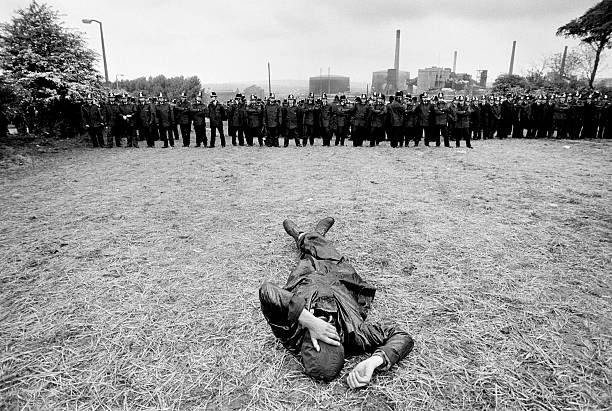
Image: GETTY images
The North, traditionally heavily reliant on manufacturing, suffered greatly from this global shift. Furthermore, since the 1980s, regional economic inequality has skyrocketed; by 2019, average wages in London were 60% higher than those in Scarborough (Oxford Open Economics). Thatcher has become the figurehead of this economic decline in the North, understandably in the wake of her government’s confrontation with the National Union of Miners in 1984 and the economic restructuring policy that accelerated Britain’s shift away from manufacturing. While this shift had already been underway – with foreign manufacturers able to produce goods at a cheaper cost – it disproportionately hit working-class communities, especially those in the North of England, Scotland and Wales, including the constituency of Makerfield (created in 1983). This regional inequality became baked into the British economic map, with prosperous London and the South East a stark economic outlier relative to, specifically, the North.

While these structural economic forces should never be ignored, working-class communities saw Thatcher’s government take away their livelihood and then implement no alternative economic strategy for the region. Politicians in London took their employment away, and in tandem, their community, with no alternative even considered, let alone implemented. Hence the gaping inequality, and hence the anger towards a perceived political class that simply does not listen. This is fertile ground for populism, helping explain why these communities voted overwhelmingly for Brexit in 2016 – the ultimate implication of anti-system voting - and in large swathes for Reform in the 2026 local council elections. The example of Makerfield is a perfect case in point.
Chart 1 - ONS GOV UK
A Politics That Doesn't Care
These political concerns had been central in these regions since the close of the century, yet they had never been addressed. While public spending in such deprived areas rose under New Labour, and urban regeneration projects such as Newcastle’s Quayside redevelopment – typified by construction of the Glasshouse Gateshead in 2004 – showcased the power of targeted investment, the key structural causes of regional economic inequality remained totally untouched. Much of New Labour’s policy on reducing regional inequality was centred around devolution; effective for Scotland and Wales, yet the prospect for English regions ended completely following the 2004 North East England devolution referendum, where 77.9% voted against the prospect.
Therefore, upon seeing a Labour government fail to address the structural issues behind regional inequality – the loss and failure to replace traditional industries, chronic underinvestment and poor relative productivity – voters began to question whether the PLP truly represented their interests or simply considered their communities’ support a foregone conclusion. Moving forward to the 2019 general election, this sentiment was reactivated. Johnson proposed policies which made these left-behind voters feel heard and valued; unfortunately, such promises proved hollow.
The Failed Policy of Levelling-Up
Regional inequality entered centre stage in the 2019 election, with Johnson’s flagship policy ‘levelling-up’ proving a popular concept to voters in Labour’s traditional heartlands. The policy had three loosely defined missions to combat regional inequality: to boost pay and productivity, improve opportunities – for example, through improvements in infrastructure and transport – and to generally reduce regional inequalities through investment into neglected towns and cities. Speaking in 2021, Johnson acknowledged that the UK economy was “more unbalanced than pretty much every major developed country”, going on to say that “for too many people geography turns out to be a destiny”. This rhetoric suggested that regional inequality was finally set to be addressed, ironically by the Conservative party that many in these communities would argue caused such economic inequality.
However, the ambitious project yielded minimal results. COVID-19, political instability, economic pressures on government spending and simply the enormous scale of the structural issue proved too much. This could be exemplified by the cancellation of the northern leg of HS2 from Birmingham to Manchester in October 2023, alongside the inadequacy of Johnson’s levelling up policy to meet the structural problems behind regional inequality. Thus, voters who were already growing increasingly disillusioned once more saw a government in London abandon them. Anger and frustration with the status quo have laid the groundwork for Reform, yet Andy Burnham’s utilisation of ‘northern populist sentiments’ could be set to buck this trend.
Exploring a Northern Populist Narrative
Following on from this contextual description, this section will seek to establish this concept. To define this notion, an understanding of populism in general must be reached. One of the leading thinkers on this topic is Cas Mudde, who defines populism as a ‘thin-centred’ ideology that perceives society as split into two, homogenous and antagonistic groups: the corrupt elite and the pure people whose general will must be carried out. See chapter 1 of Mudde’s ‘Populism: A Very Short Introduction’ for the full details. Evidently, this definition does not apply to the politics that Burnham advocates for. Yet the political narrative animating much of the politics within northern working-class towns, such as Makerfield, certainly fits snugly into this archetype – with the “pure people” representing the damaged working-class communities and “corrupt elite” representing politicians in London, exemplified by Thatcher, who are certainly depicted as antagonistic, or at the very least, uncaring.
The notion of ‘northern populism’ is in no sense an ideology; it is a collective perception or political narrative that frames Northern communities as victims of neglect by a distant, elite class of London politicians. Following on from this, the general will of the ‘people’ can be seen as a return to the economic security provided by the old manufacturing industries that had collapsed by the 1980’s. Yet what those who subscribe to this notion of northern populism truly wish to return to is not the manufacturing industries themselves, but the secure forms of employment and resulting prosperity relative to the rest of the country that preceded deindustrialisation. The distinction between the economic prosperity and security provided by traditional manufacturing industries and the actual industries themselves must be made; the true conclusion of this northern populist narrative is a return to the former, not the latter. This must be recognised and articulated by Burnham if he is to effectively use this significant political force prevalent across the red wall.
Now, Burnham is no populist. He does not project the simplified politics of the people against the elites and has long criticised the kind of populist politics peddled by Reform. It is understandable for Burnham to remain silent on Zak Polanski’s populist categorisation of British politics in order not to jeopardise prospects of a progressive coalition in the next general election, yet this is no suggestion that he subscribes or is sympathetic in any way to this view.
Yet his campaign in the Makerfield by-election is certainly playing on the themes of Northern populism. In rightly recognising the feeling within similar communities of being politically left behind, and in fondly thinking back to 40 years ago, when such communities were united and more prosperous before the ‘London elites’ interfered, Burnham strays near a dangerously simplistic diagnosis of the problems of Britain’s forgotten communities. His rhetoric risks encouraging an economic nostalgia for an economic model that is no longer feasible.
He must not translate what is currently a political strategy for the Makerfield by-election into a nationwide economic approach. Instead, he should rewrite the solution to the problem set forward by the ‘Northern populist sentiment’, forgoing a simplistic desire to return to the past and reframing it as a recognition of what these communities must demand from emerging economic sectors in the future. Simply put, Burnham should centre investment into new sectors of employment to reinvigorate these communities, rather than solely play on nostalgia for past economic security and certainty provided by manufacturing. Thus, Burnham is benefiting from a populist narrative, and if successful, will transform the theoretical destination of the sentiment. This could prove to be a winning formula, electorally and with the prosperity of these communities in mind, if these distinctions are understood.
Confronting Neo-Liberalism Through This Lens
Burnham has effectively tapped into themes of discontent prevalent across the red wall. Justifiable anger at the impact of neo-liberalism, trickle-down economics, the destruction of northern industry, and privatisation have all, to differing extents, been important to his campaign. Consequently, while trust in the possibility of politicians following through on their promises has worn thin amongst these communities, Burnham seems set to win on this ticket. While these problems do, as Burnham points out, run back 40 years, it is a mistake to attribute them solely to Thatcher and the economic restructuring that she led during her premiership. Although the decline of manufacturing was largely inevitable, chronic underinvestment in affected regions prevented the emergence of new industries capable of sustaining local economies and narrowing regional inequalities. Yet the narrative in these communities, which is ripe for populist exploitation, is that this regional inequality can be blamed wholly upon Thatcher and an antagonistic class of political elites. Burnham must not go down this path, and specifically, he must not take on board the solution this narrative proposes: a return to what once was.
As Tony Blair noted in his recent critical essay, it would be wrong to suggest that “nothing good came out of the past 40 years of neo-liberalism”. This is a valid suggestion, yet the true picture of regional inequality is far closer to Burnham’s analysis than Blair’s. Indeed, Blair's New Labour, as we have seen, failed to address the structural economic causes of widening regional inequality. The nation’s economy has moved on from manufacturing and can never return. Yet, regional inequality is not a necessary side effect of this. The answer is not a return to the 1970’s, nor is it the continuation of the status quo. In continually referencing the past 40 years of neo-liberalism, Burnham has positioned himself against the titanic political figure of Thatcher, an electorally popular stance for Makerfield, but it will prove a less popular and effective stance when considering the nation.
What communities such as Makerfield, and voters across the nation have always desired is the opportunity to work towards prosperity. New economic sectors must be encouraged to establish in neglected communities throughout the red wall, through both private and public investment. New areas of employment must be encouraged to stimulate local economies that have lacked for so long the required impetus to flourish. Johnson promised this first in 2019, yet Burnham could follow through nearly a decade later.
Jon Snow on a Policy Tightrope
Therefore, the prospective prime minister is having to walk a thin policy tightrope in alluding to policy that fits the bill for this ‘Northern populist’ sentiment, while not centring his entire economic proposal for the region, and more importantly, the wider nation, on a nostalgia for when Britain was a workshop for the world. In this, he must be commended.
Burnham’s rhetoric has been very focused on the ineffectiveness of trickle-down economics in reaching ‘left behind’ areas such as Makerfield. Importantly, speaking to supporters in a campaign speech in Wigan on the 15th June, he promised a politics “where the investment comes, as it always should have come”. This is an apt analysis of problems facing such communities, the same analysis drawn by Johnson in 2019, yet hopefully Burnham has greater motivation to follow through. In this, Burnham has highlighted the true reason for the inadequacy of successive governments in addressing regional inequality since the 1980’s. Following the closure of traditional manufacturing industries, the central reason why economic inequality remained and widened, and why inequality of opportunity existed, was that chronic underinvestment across neglected areas of the nation meant no new economic forces emerged in such areas to help keep pace relative to the rest of the UK.
This is not an all-encompassing economic model for the future of the nation. It is, however, what is required to reduce the gaping geographical inequalities present and to quell the rise of the populist right. This is a position that Burnham must maintain; that the answer is new investment and a new direction, rather than the stale argument for a return of old industries, and to a lesser extent, total nationalisation. Burnham’s challenge is to channel legitimate economic grievances around regional economic decline into a forward-thinking economic programme centred around investment. The danger lies in the desire evoked by such grievances for a return to the past, suggesting Burnham may propose a nostalgic economic package that simply does not apply in the modern world. This new package must centre around investment into new sectors of the economy for disadvantaged regions, rather than on a return to arguments around industry of old or sentiments of nationalisation being the silver bullet to solve the UK’s economic problems .
More of the Same?
Neglected communities such as Makerfield have been given false hope before by Westminster politicians. This has greatly fuelled the Northern populist sentiment. While Burnham’s regional connection has reassured many voters in the constituency that he genuinely cares about the issue of regional inequality, he must back this up with action. His election, if he does eventually enter Downing Street, must herald private and public investment into these regions, and more broadly, must result in declining regional economic inequality. If Burnham fails in this, he will contribute to the possibly fatal erosion of support for the PLP amongst these communities, to a growing consensus that politicians don’t care about such communities and would likely set the scene for a Farage government. The progressive, centre-left case would be left impossible to argue for in these regions. Yet most importantly, it would mean such long-suffering communities would continue to face economic inequality and persistent inequality of opportunity. No pressure, Andy.
References
- [YOUGOV, 'How do Briton's feel about Andy Burnham comeback' (27th January 2026)https://yougov.com/en-gb/articles/53951-how-do-britons-feel-about-an-andy-burnham-comeback].
- [Alex Nurse, 'Levelling-Up has been a total failure - here's the evidence' for The Conversation (10th June 2024) https://theconversation.com/levelling-up-has-been-a-total-failure-heres-the-evidence-231328. And Jack Newman, 'What is levelling up - what we know about Johnson's agenda and what we don't' (23rd July 2021) https://theconversation.com/what-actually-is-levelling-up-what-we-know-about-boris-johnsons-agenda-and-what-we-dont-164886].
- [PollCheck, 'Makerfield By-Election: Candidates, Polls and Result (5th June 2026) https://www.pollcheck.co.uk/by-elections/makerfield]
- [Boris Johnson, 'The Prime Minister's Levelling Up Speech' (15th July 2021) GOV.UK, https://www.gov.uk/government/speeches/the-prime-ministers-levelling-up-speech-15-july-2021].
- [Josh Halliday, '"We're forgotten about here": the broken promises of levelling up' for The Guardian (1st April 2024) https://www.theguardian.com/uk-news/2024/apr/01/were-forgotten-about-here-the-broken-promises-of-levelling-up].
- [Cas Mudde, and Cristóbal Rovira Kaltwasser, 'What is populism?', Populism: A Very Short Introduction, Very Short Introductions (New York, 2017; online edn, Oxford Academic, 23 Feb. 2017), https://doi.org/10.1093/actrade/9780190234874.003.0001, accessed 16 June 2026].
- [Henry G Overman, Xiaowei Xu, Spatial disparities across labour markets, Oxford Open Economics, Volume 3, Issue Supplement_1, 2024, Pages i585–i610, https://doi.org/10.1093/ooec/odae005].
- [Andy Burnham, speech to supporters in Wigan (13th June 2026), https://www.youtube.com/watch?v=0xs4r6UNdyI].
- [Office for National Statistics, 'What are the regional differences in income and productivity' 17th May 2021, https://www.ons.gov.uk/visualisations/dvc1370/index.html].
- [IFS, 'Tackling regional inequalities: lessons from new research' (15 January 2026), https://ifs.org.uk/articles/tackling-regional-inequalities-lessons-new-research]
Join the Discussion
Please keep contributions respectful and focused on the article's insights. We value diverse perspectives and constructive dialogue.
Related Reading


ELECTION FORECAST
The Shift in Youth Agency: Analyzing the Latest Voter Turnout
PROGRESSIVE EDITORIAL
Reclaiming Democracy: Why Youth Participation is Non-Negotiable
OPINION PIECE